The Hidden Costs of Legacy Payment Infrastructure
The expensive costs of legacy payment systems never appear on an invoice. They surface as estimate drift, hiring difficulty, compliance findings, and product options you quietly stop considering. How to find them and what to do first.
Updated July 2026.
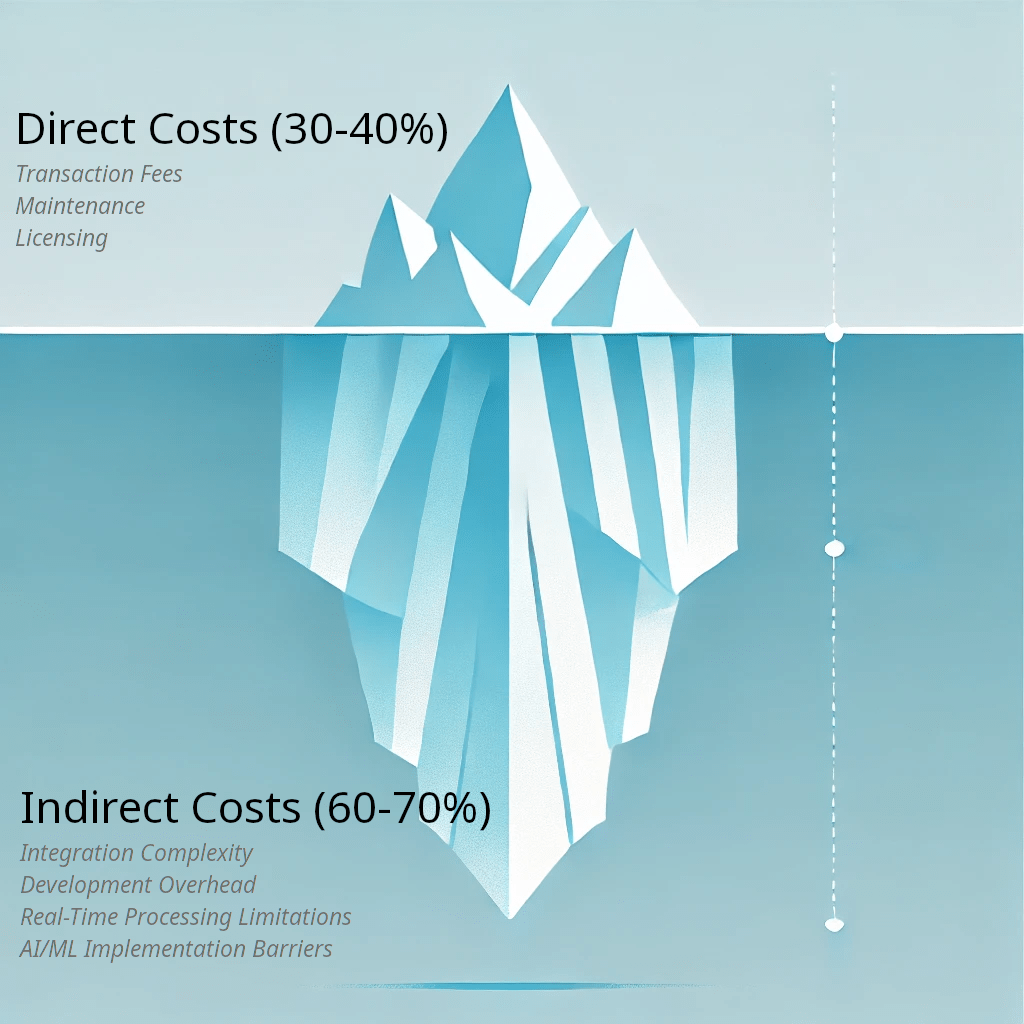
Every organization running older payment infrastructure can tell you what it costs. They will quote licensing, maintenance, and per-transaction fees, and those numbers will be accurate.
They will also be the small part. The costs that matter do not appear on an invoice, which is precisely why nobody manages them.
Four costs that never show up in the budget
Estimate drift on integration work. This is the most reliable diagnostic available. Watch what happens to estimates specifically on work that touches the payment layer. When a connection that reads like a two-week task consistently lands at two or three months, the estimates are not the problem. Engineers trained on REST APIs and event-driven systems are landing in fixed-width files, batch windows, and synchronous calls with no idempotency guarantees. The work is not conceptually difficult. It is slow, unfamiliar, and unusually easy to get subtly wrong.
Hiring friction. Senior payments engineers ask what the stack looks like. Some of them decline afterward, and they do not tell you that was the reason. The cost is invisible because it is a non-event: a candidate who never entered the pipeline. Over a couple of years this compounds into a team that is capable but junior in exactly the domain where you most need depth.
Compliance surface area. Older systems tend to hold card data in more places, log more than they should, and segment less cleanly than a modern design would. Every one of those is scope on a PCI assessment, and scope is the single largest driver of both audit cost and remediation work. You pay for that architecture annually, forever, through an assessment fee that has nothing to do with the technology's age.
Options you stop considering. The largest cost, and the hardest to see. Real-time payouts, embedded finance partnerships, a new geography, instant settlement. These get evaluated, priced against the existing platform, and quietly dropped. Nobody records a decision not to pursue something. But if you look back over two years of roadmap discussions and find a pattern of good ideas that died at feasibility, that pattern is the cost.
The AI-readiness problem underneath
There is a specific version of this that has become acute.
Fraud scoring, underwriting models, and anomaly detection all need the same thing: clean, complete, well-labeled transaction data available with low latency. Batch-oriented platforms typically produce data that is clean enough for reporting and not clean enough for modeling: reconciled at end of day, missing intermediate state, with the fields a model would want most having been derived rather than recorded.
This is why "we should add ML to fraud" so often stalls after the pilot. The model was never the constraint. The data substrate was, and it was decided years earlier by an architecture nobody expected to still be running.
What to do first
The instinct is to plan a replacement. Full replacements of payment infrastructure have a poor track record. They take longer than projected, and the business does not stop needing changes while they run.
A more reliable sequence:
Measure before deciding. Instrument what you actually have. Real processing times, real failure rates, real engineering hours by subsystem. Most modernization business cases are built on assumption, which is why they lose to whatever else is competing for the budget.
Put a modern interface in front of the old system. An API facade lets new development proceed against a sane contract while the legacy platform keeps running underneath. This is unglamorous and buys more than it looks like it should.
Get the data out. Event streaming for transaction data, into a store you control. This unblocks analytics and modeling without touching the core, and it is usually the highest-value early move because it decouples the data problem from the platform problem.
Then replace by business impact. Component by component, sequenced by what is costing the most rather than by what is technically most offensive. These are rarely the same thing, and engineering instinct reliably picks the second.
The part that makes it hard
None of this is technically difficult. It is difficult because the costs are invisible and the remediation is visible.
A modernization program shows up in the budget as a large number with a multi-quarter timeline. The thing it fixes shows up nowhere, because estimate drift, declined candidates, audit scope, and unpursued options are not line items. Whoever proposes the work is arguing for a certain cost against a diffuse benefit.
Which is why the measurement step is not optional preparation. It is the entire argument.
If you are working through this, see payment systems modernization for how we approach it, or book a call.