FinStatement Parser - The Missing Piece in Financial Data Extraction
Discover FinStatement Parser, an open-source Python library that extracts structured data from financial statement PDFs. Stop building custom parsers and automate your financial data extraction today.
Financial developers have long struggled with a surprisingly persistent problem: extracting structured data from bank statements and credit card PDFs. While the industry has made significant strides in API-based data access, millions of financial documents still arrive as PDFs, trapping valuable data in formats that resist automation.
Today, we're excited to spotlight FinStatement Parser, an elegant open-source solution that tackles this exact problem.
The PDF Statement Problem
Every financial application ultimately needs access to transaction data, balances, and account details. Modern applications can use APIs and data aggregators when available, but PDF statements remain ubiquitous for several reasons:
- Many institutions still primarily deliver statements as PDFs
- Historical data is often only available in PDF format
- Users frequently have PDF statements when onboarding to new services
- Many business processes still depend on statement uploads
These PDFs are designed for human readability rather than machine processing, and they vary wildly in format between institutions. The result is a great many engineering hours spent building brittle, one-off parsers.
FinStatement Parser: One Week to Production
FinStatement Parser is a focused, powerful open-source library built around a simple premise: extracting structured financial data from statements should be a solved problem.
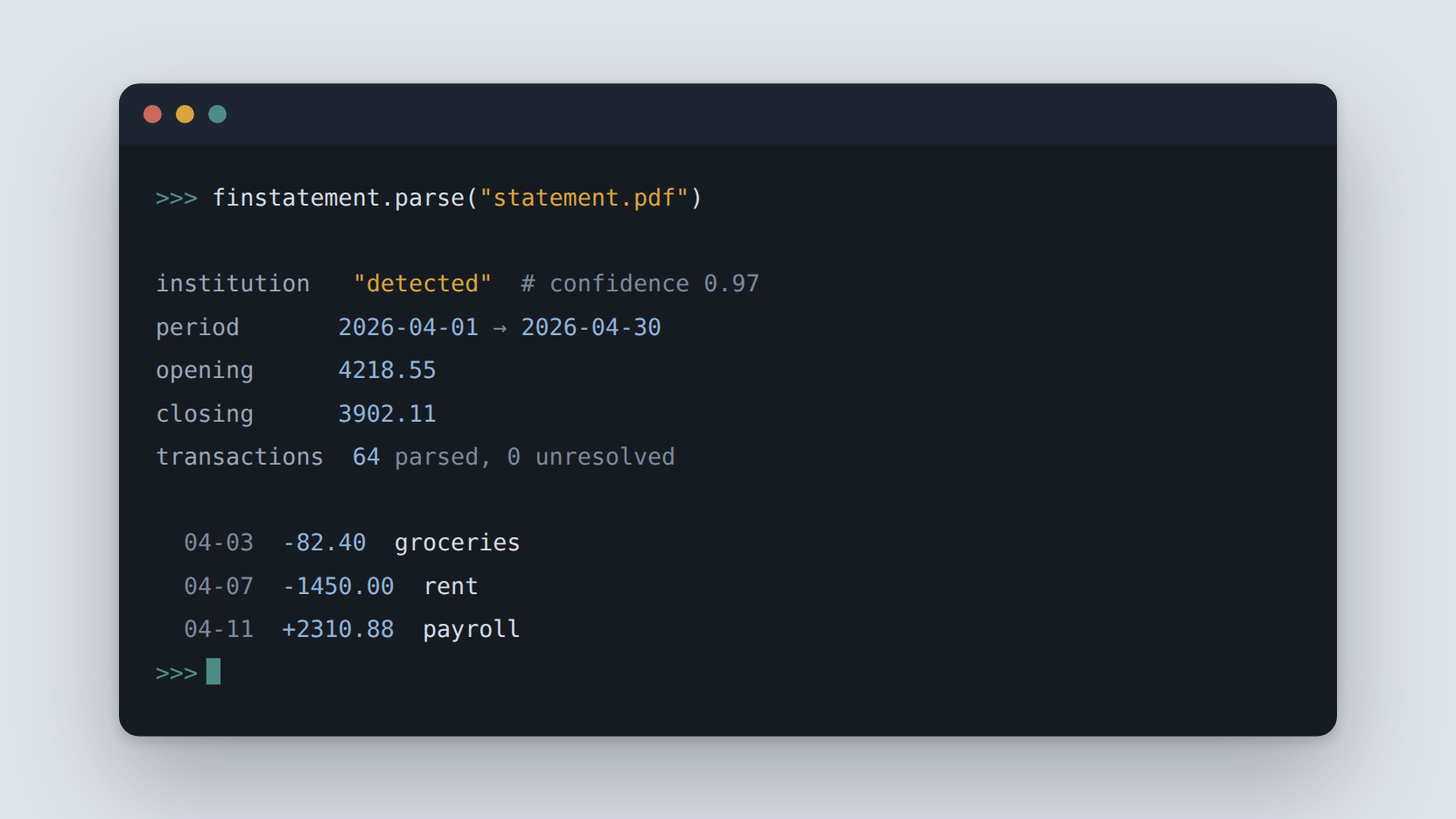
With a lightweight API and smart institution detection, it transforms this historically painful process into a single function call:
import finstatement

# Parse a statement
result = finstatement.parse("statement.pdf")

# Access structured data
print(f"Account: {result.account_info.number}")
print(f"Period: {result.period.start} to {result.period.end}")
print(f"Closing Balance: ${result.balance.closing}")

# Process transactions
for tx in result.transactions:
    print(f"{tx.date} | ${tx.amount} | {tx.description} [{tx.category}]")
Key Features
What sets FinStatement Parser apart from other attempts at solving this problem:
- Universal PDF Extraction: Works with statements from all major US financial institutions
- Automatic Institution Detection: Identifies the source institution and applies specialized parsing
- Transaction Categorization: Automatically classifies transactions into categories like "dining" or "transportation"
- Confidence Scoring: Quantifies the reliability of extracted data
- Batch Processing: Efficiently process multiple statements in parallel
- No External Dependencies: Core functionality requires only Python and PyPDF2
Built for Developers, By Developers
FinStatement Parser was developed by AZdev, FinTech engineering specialists, after encountering this exact pain point across multiple client projects. Rather than building yet another internal tool, they decided to release it as an MIT-licensed open source project.
The project follows a "narrow but deep" philosophy, focusing on solving one problem exceptionally well rather than trying to be a comprehensive financial data platform.
Real-World Applications
Financial developers are already using FinStatement Parser to:
- Build Personal Finance Apps: Import data from users' historical statements
- Accelerate Loan Processing: Extract transaction history for affordability checks
- Automate Expense Analysis: Process corporate card statements in bulk
- Enhance Banking Onboarding: Import transaction history from previous institutions
Community-Driven Expansion
While the core library handles the most common US institutions, its modular design makes it easy for the community to extend support. The team encourages contributions, particularly for:
- Additional financial institutions
- International statement formats
- Specialized statement types (investment, mortgage, loan)
- Enhanced transaction categorization models
Where it fits
Financial data extraction doesn't have to be a headache. FinStatement Parser provides a well-built, open-source solution that "just works" for the most common use cases while providing a solid foundation for more specialized needs.
Check out the GitHub repository to get started, and join the growing community of developers who never want to write another PDF statement parser again.
FinStatement Parser is released under the MIT license and maintained by AZdev, FinTech Innovation Execution Leaders.