Why Most FinTech ML Models Never Reach Production (and How to Close the Gap)
The lab-to-production gap kills more FinTech ML projects than model quality ever does. The infrastructure, governance, and engineering disciplines that actually get models into production.
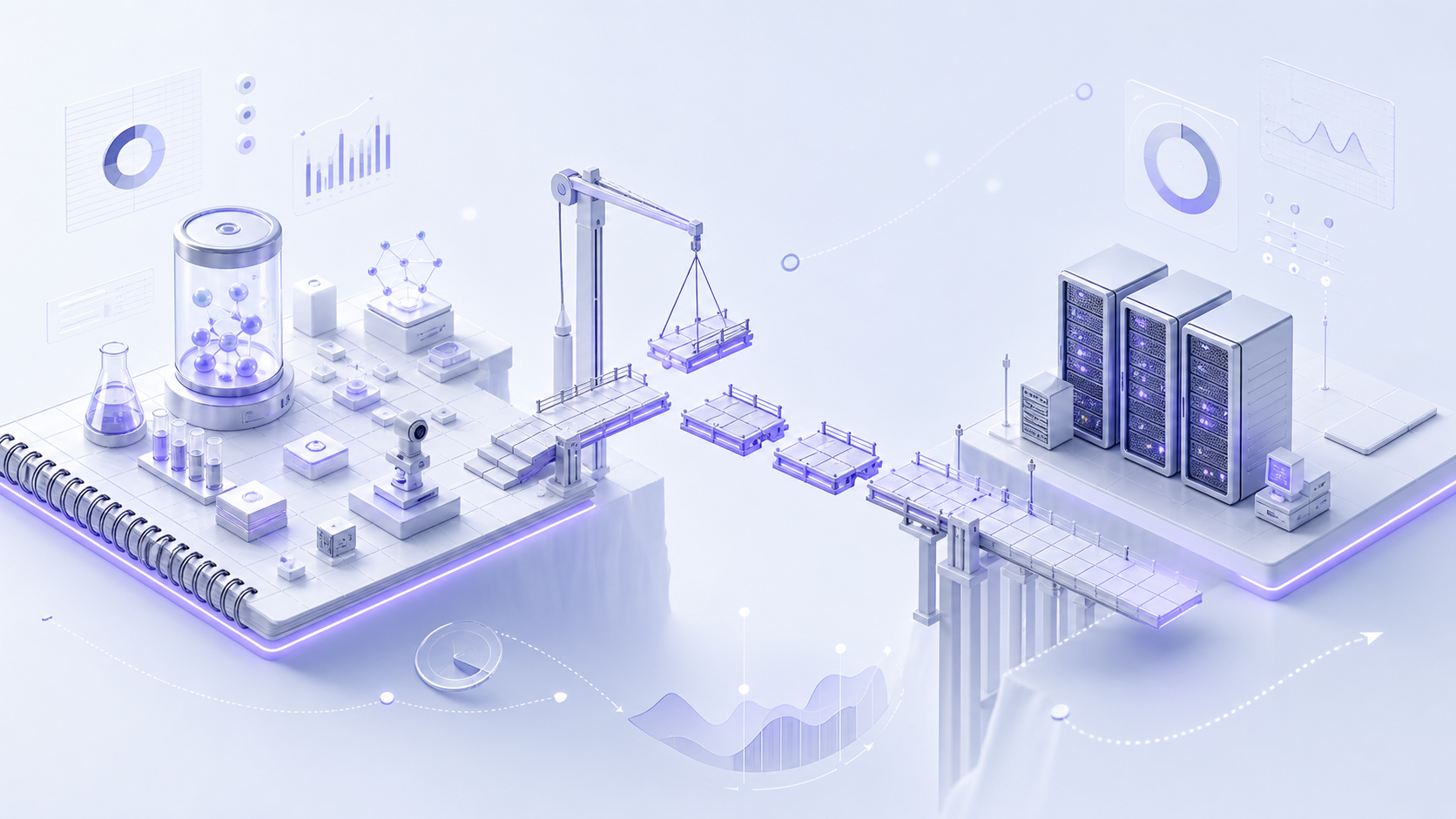
Most FinTech ML projects fail not because the models are bad, but because the gap between a working model in a notebook and a model running in production is enormous, and the work that closes the gap is not what data science teams are usually staffed to do.
We see this repeatedly. A talented data science team builds a fraud model, a credit-risk model, or an LLM-driven feature. It works in evaluation. It is presented to leadership. Six months later it is still not in production. Twelve months later the team is still saying "almost ready." The pattern is rarely about model quality. It is about the infrastructure, governance, and engineering disciplines required to run a model against real customer traffic, and the fact that almost no early-stage FinTech is structurally set up to do this work.
This piece is what we tell FinTech leadership about the lab-to-production gap, and what closing it actually takes.
The gap is not what most teams think
The story founders are told is: "We hired a great data science team. They build great models. We just need to ship them."
The reality is: data science teams are usually optimized for finding models that work. The work between "model that works on a held-out evaluation set" and "model that runs reliably against real customer traffic, returns correct results in real time, monitors for drift, retrains on a cadence, has audit trails, and survives a regulatory examination" is a different discipline. That discipline, call it ML engineering or MLOps, is rarely what data science hires are trained for.
The gap shows up in five specific places.
Place one: inference infrastructure
A model in a notebook runs whenever the data scientist runs it. A model in production needs to run on every relevant transaction in your system, in milliseconds, with proper handling of degraded states.
What this requires:
- Sub-second decisioning for transaction-time use cases (fraud, risk).
- Graceful degradation when the scoring service times out: falling back to rules, conservative defaults, or rejection-with-retry, depending on the use case.
- Cost control. Inference compute scales with transaction volume. Without architectural attention, this becomes the dominant cost line item.
- Multi-model routing when you have models from different providers (OpenAI, Anthropic, in-house) chosen by task type and cost.
Most data science teams have not built this. Most engineering teams have not had to.
Place two: evaluation that holds up over time
In a notebook, evaluation means computing accuracy/precision/recall/AUC on a held-out set. In production, evaluation needs to:
- Run on every model version against a curated set of held-out cases.
- Detect regressions when a new model version performs worse on edge cases that matter.
- Run against the same set across model swaps so comparisons are valid.
- Handle the asymmetry of finance use cases. False positives have one cost profile, false negatives have a totally different one.
Teams without proper evaluation harnesses ship models on intuition and find out which version was worse from production incidents. Teams with proper harnesses ship faster and more confidently.
Place three: monitoring and drift detection
A production model has to be monitored for performance and for drift in the input distribution. This is not optional for finance use cases. Regulators expect it, and the cost of an undetected drift in a fraud or credit model is high.
What good monitoring looks like:
- Input distribution drift detection. Are the inputs to the model the same shape as the training data?
- Output distribution drift detection. Are the model's outputs distributed similarly to what you expect?
- Performance monitoring against ground truth as labels become available (for fraud, this might be 60-90 days later when chargebacks finalize).
- Alerting on drift signals that requires investigation before the next planned retrain, not after.
Most early-stage FinTechs have none of this. Building it requires both data engineering and ML engineering, usually as a coordinated effort.
Place four: model governance and audit trails
Models that touch finance, whether credit decisions, fraud decisions, or LLM-driven customer interactions, face increasing regulatory expectation around governance. NYDFS Part 500, the AI Bill of Rights, increasing scrutiny from federal banking regulators.
Governance means:
- Versioning. Every model version that ran against production traffic is identifiable and reproducible.
- Decision rationale documentation. Why did you pick this model architecture, this training data, this threshold? Documented in a way auditors can read.
- Bias and fairness monitoring for any model that touches credit, lending, pricing, or access decisions.
- Audit trail of every prediction made on production traffic, queryable for at least the regulatory retention period.
- Human review checkpoints for high-impact decisions, with the human-in-the-loop workflow documented.
Teams without this run into walls during audits, regulator examinations, and partner due diligence.
Place five: retraining cadence and handoff
Models drift. The retraining pipeline has to be:
- Automated where possible. Manual retraining means it does not happen on the cadence the model needs.
- Reproducible. Same training data, same hyperparameters, same model, every time.
- Evaluated against the evaluation harness before deployment.
- Rolled out with proper canary or shadow-mode deployment before full traffic cutover.
- Owned by someone. When the data scientist who built it leaves, the retraining pipeline cannot be lost.
The "someone owns it" part bites the hardest. A retraining pipeline whose tribal knowledge sat with one engineer fails the moment that engineer changes roles.
The pattern that closes the gap
Teams that get models reliably into production tend to share four practices:
- ML engineering is its own function, not a side responsibility for data scientists or backend engineers. Even at small teams, someone owns the infrastructure layer specifically.
- The first model in production is small. A simple rules-plus-ML hybrid that ships beats a sophisticated ensemble that does not. Once one model is in production with proper infrastructure, subsequent models ride the same rails.
- Evaluation harness comes before model two. The gap between "ship one model and call it done" and "ship many models over time" is whether the evaluation infrastructure exists.
- Compliance and governance are baked in from the start. Adding governance to a production model after the fact is harder than building with it from day one.
What to do if you are stuck in the gap
If you are an early-stage FinTech with a model in research that has been "almost ready" for six months:
- Honest read on what is missing. Usually it is two of: inference infrastructure, evaluation harness, monitoring, governance. Identify which.
- Pick the smallest possible production scope: a low-stakes use case where you can build the infrastructure rails, and ship that. Then expand.
- Decide what your team builds and what you outsource. Some teams should run their own inference; some should use vendor scoring services. The decision depends on data residency, latency, cost, and how much MLOps capability you can sustain.
- Bring in an ML engineering perspective if you do not have one in-house. This is one of the highest-leverage hires or engagements at the right moment.
The teams that close this gap end up with a sustainable platform for shipping ML features. The teams that do not end up with prestige projects in research that never produce business value.
We help FinTechs close the lab-to-production gap. See AI/ML engineering for finance and FinTech for what an engagement looks like, or book a call for an honest read on what is keeping your models out of production.
Models do not fail because they are bad. They fail because the work between "model that works in evaluation" and "model that runs in production" is its own discipline, and most teams do not realize that until they have spent twelve months trying to bridge the gap with the wrong tools.