GENIUS Act: The Rules Missed Their Deadline, and Which Date Binds You Depends on What You Do
Regulators missed the 18 July 2026 deadline for final GENIUS Act rules. The statute still takes effect by 18 January 2027. Which provisions reach a credit union or community bank on that date, and which wait until 18 July 2028, turns on what the institution actually does.
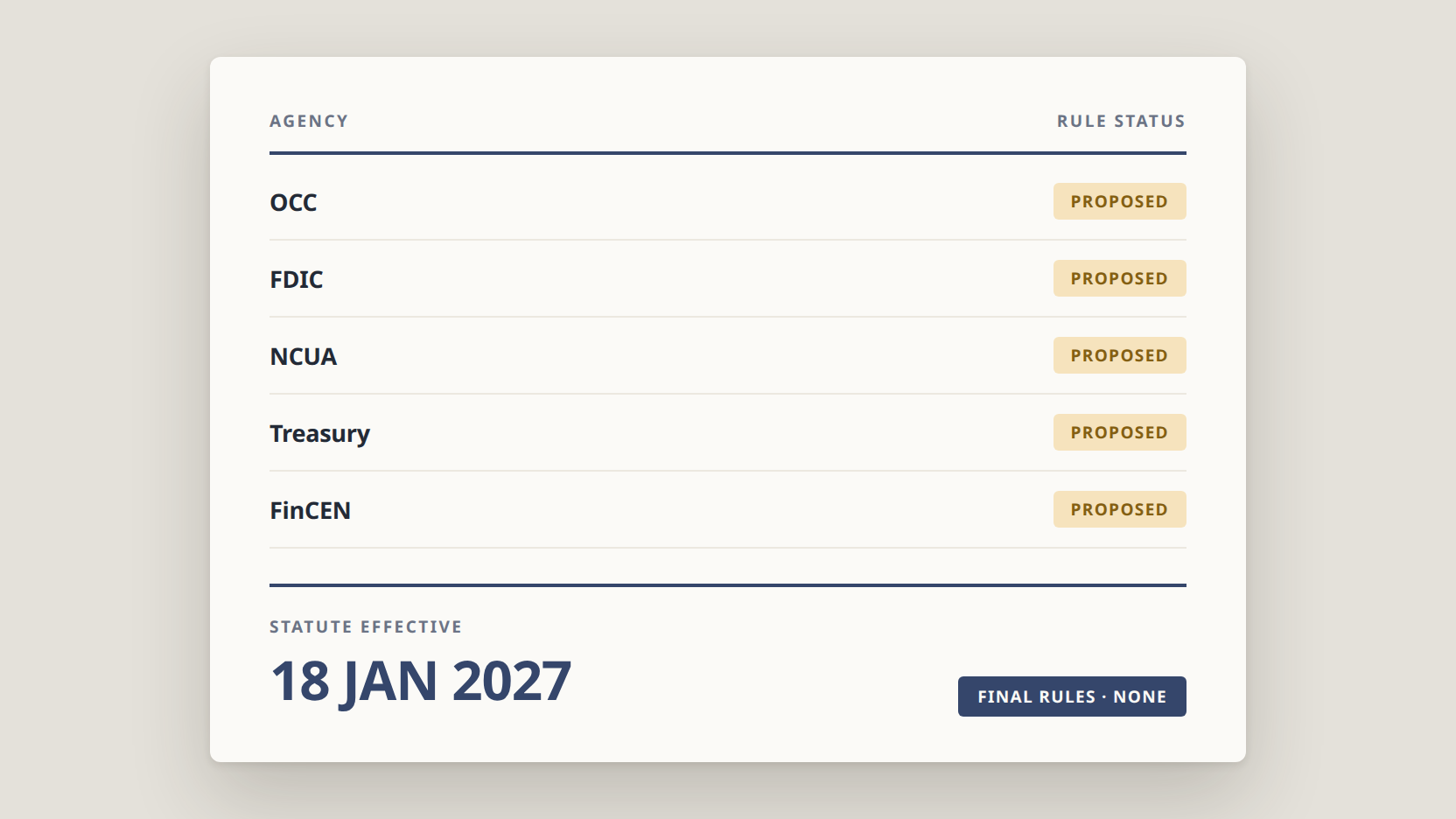
Ten days ago, on 18 July 2026, the statutory deadline for federal agencies to publish final rules under the GENIUS Act passed. No agency met it.
That sounds like a reprieve, and for once the obvious reading is close to right: the miss pushed the effective date later, not sooner. What it removed is the guarantee that any of that time follows a settled rulebook.
There is a second point that matters more for most credit unions and community banks. Whether January 2027 reaches you at all, and which parts of the Act do, depends on what your institution actually does with stablecoins rather than on what kind of institution it is.
When does the GENIUS Act actually take effect?
The GENIUS Act was enacted on 18 July 2025. It takes effect on the earlier of 18 January 2027, or 120 days after the primary federal payment stablecoin regulators issue final regulations.
Read the second branch carefully, because the wording does more work than it appears to. Section 20 starts the clock 120 days after the regulators issue any final regulations. Whether one agency acting alone is enough to start it, or whether the plural requires more, is genuinely arguable and unresolved. Either way the clause does not promise you 120 days with a settled rulebook, and it delivers its full 120 only while there is still room to fit them before the January backstop. There is one date where that stops being true.
That date is 20 September 2026. Work it backwards: 18 January 2027 minus 120 days.
| Final rules issued | Effective date | Transition you get |
|---|---|---|
| 1 August 2026 | 29 November 2026 | 120 days |
| 20 September 2026 | 18 January 2027 | 120 days (the crossover) |
| 1 October 2026 | 18 January 2027 | 109 days |
| 1 December 2026 | 18 January 2027 | 48 days |
| February 2027 | 18 January 2027 | none, the statute is already live |
Before 20 September, slippage moves the effective date later and the transition period stays whole. After it, the January backstop bites: the effective date stops moving and every further week of delay comes out of the preparation time available to anyone who has to comply on day one.
Had regulators finalized on time, the 120-day clock would have made the Act effective around 15 November 2026. That date is now out of reach, and each week without a final rule pushes the earliest possible effective date further out. Under an "earlier of" structure the 120-day branch can only pull the date forward, never back, so 18 January 2027 is the statutory maximum runway and nothing can extend it.
So far the miss has bought calendar time rather than spent it. What it put at risk is the transition period, and that erosion begins on 20 September.
Where each agency actually stands
Per the Chapman and Cutler rulemaking tracker and a check of the Federal Register, no implementing final rule exists as of today. Only four bodies are "primary Federal payment stablecoin regulators" under section 2(25), and only their final rules start the clock. Treasury and FinCEN shape the regime and cannot trigger the effective date at all.
| Body | Starts the 120-day clock? | Status |
|---|---|---|
| OCC | Yes | Implementation NPRM, 25 February 2026. Creates a new 12 CFR 15 |
| FDIC | Yes | Licensing NPRM December 2025, Implementation NPRM April 2026 |
| NCUA | Yes | Licensing NPRM February 2026, supplemental proposed rule May 2026 |
| Federal Reserve Board | Yes | Joint issuer of the June CIP NPRM, but its own section 7(e)(1)(B) rulemaking is still pending |
| Treasury | No | ANPRM September 2025, substantially-similar and AML NPRMs April 2026 |
| FinCEN | No | Joint CIP NPRM, June 2026, with the banking agencies |
The Federal Reserve row is the one to look at. Section 7(e)(1)(B) required the Board to issue rules setting out the unusual and exigent circumstances in which it may act, on the same 18 July 2026 timetable. The OCC discharged its mirror obligation in March. The Board has not.
Which parts of the Act reach you, and when
Different provisions attach to different conduct on different dates, and the distinction is worth getting right before anyone quotes a single deadline at your board.
If you do nothing with stablecoins, very little attaches. Section 3(a) binds issuers, section 10 binds custodians of reserves and private keys. Neither describes you.
If you distribute, exchange, transfer or custody them, you are a digital asset service provider, and this turns on conduct rather than charter. Section 2(7) defines the term by activity, its exclusions are all technology carve-outs with no exemption for banks or credit unions, and section 16(a)(3) expressly contemplates credit unions providing custodial services. For that institution, most of the Act arrives on 18 January 2027, not later: section 3(b)(2) covers stablecoins from foreign issuers with no delayed date, and section 3(g)(3) means a non-permitted stablecoin is not acceptable as a settlement asset for wholesale payments between banking organizations.
One provision, and only one, waits until 18 July 2028. Section 3(b)(1) makes it unlawful for a digital asset service provider to offer or sell a domestically issued payment stablecoin that did not come from a permitted issuer. That date is keyed to enactment, so no rulemaking slippage moves it. It is a genuine extra eighteen months, and it applies to a narrower slice of activity than the headline suggests.
Section 4(e) binds everyone, issuer or not. Section 4(e)(2) makes it unlawful for any person to represent that a payment stablecoin carries federal deposit or share insurance, and 4(e)(3) bars marketing a product as a payment stablecoin unless it was issued under the Act. This is the provision most likely to reach an institution that thinks it is a bystander.
One oddity is worth carrying into a board conversation. Section 5(a)(2) required regulators to be accepting applications before 18 July 2026, and they are not, so January would arrive with issuance restricted and no working route to becoming a permitted issuer. Relief of some kind looks likely, and section 5(f) allows a twelve-month waiver in narrow circumstances.
What this means for a credit union or community bank
Almost none of you should be issuing a stablecoin. The capital requirements, reserve management, redemption obligations, and supervisory burden are real, and the frameworks defining them are not final. If a vendor is pitching a white-labeled issuance product on a January timeline, the timeline alone should end the conversation.
Issuance is not the only role. Holding reserves for an issuer, providing custody, supporting commercial settlement, and offering tokenized deposits are four separate decisions with different risk profiles, and several fit a community institution better than issuing does. Treating "stablecoins" as one question is the mistake underneath most of the advice in both directions. Work out which of the five you are actually being asked about before deciding anything.
All of you need a written position, and sooner than January. Something the board has seen, covering what the institution will and will not do.
The reason is that the GENIUS Act is a deposit story before it is a product story. Section 4(e)(1) states that payment stablecoins are not backed by the full faith and credit of the United States and are not subject to FDIC deposit insurance or NCUA share insurance. Section 4(e)(2) makes representing otherwise unlawful for any person, routed through the enforcement provisions of the Federal Deposit Insurance Act and 18 U.S.C. 709. That distinction matters enormously to a member who is choosing where to keep money, and it matters most precisely when they do not understand it.
The questions that will reach you regardless of whether you participate:
- A member asks whether the stablecoin balance in their brokerage or payments app is insured the way their share account is. Somebody at the front line needs a correct answer.
- A commercial member asks whether you can receive or send stablecoin settlements. Today the answer is probably no, and it should be a considered no rather than a reflex.
- Your board reads a trade publication in November and asks what the institution's plan is. Having a one-page answer already written is the difference between a discussion and a scramble.
- Deposits move toward yield-bearing alternatives dressed in payment clothing. This is the actual competitive risk, and it does not require you to touch a token to be affected by it. It is the same competitive dynamic that made instant payments a requirement rather than a differentiator.
What to do before the November board meeting
Write the position paper, and put it in the November board pack. One page: what the institution will and will not do about stablecoins, which of the roles above you are open to, who owns the decision, and what would change it. November is the operative deadline here, not January, because the point is to reach the board before a trade publication does.
Train the front line on the insurance distinction. This is the highest-value, lowest-cost action available and it takes an afternoon. A member who is told something wrong about deposit insurance is a complaint, and potentially a finding.
Ask your core and payments providers what they are building. The point is not to buy, it is to know what your options will be. Your options in 2027 will be constrained by what your vendors support, and that roadmap is being set now while you are not in the room.
Watch for the final rules and read the transition period specifically. When they land, the first number to find is how long you have. Anything issued after 20 September means January governs and the transition is shorter than 120 days.
Do not launch anything yet, but do the work that survives any final rule. Vendor diligence, controls mapping, and board education are useful under every version of the framework and do not depend on final text. What should wait is committing engineering to a specific compliance interpretation. Anyone telling you the requirements are settled enough to build against has not read the tracker.
The version of this you are being sold
There is a version of this conversation, currently circulating, where community institutions must move on stablecoins now or be disintermediated. It is mostly being advanced by people selling something.
More realistically: a small number of large institutions and specialist issuers will operate in this space in 2027. Most community banks and credit unions will not, and will be fine, provided they understand where deposits are going and can answer a member's question accurately.
For an institution that is not issuing, 18 January 2027 is a market and communications milestone rather than a compliance cliff. The genuine risk is not being late to issue a token. It is being surprised by a statute that has been on the calendar since July 2025, having no board-approved answer, and discovering that the date which actually binds you is 2028 only after someone else explains it to you.
That risk costs a few afternoons to close, and about the same to ignore until January.
We help regulated institutions make technology decisions under regulatory uncertainty, including the ones where the correct answer is to wait deliberately. See technology leadership for credit unions and for community banks, or book a call.